

Does Tattoo Frost Once Already Faded
 The initial tattoo removal consultation is an important moment for every patient and every exercise.
It's an opportunity to showcase your knowledge of the procedure, establish rapport with your patient, and gain their trust so they determine to proceed with treatments.
You'll want to answer their questions thoroughly and limited your expertise in light amplification by stimulated emission of radiation tattoo removal.
We've gathered the almost common patient questions almost laser tattoo removal for your reference. Anyone that interacts with a patient – from the receptionist to the practitioner – should feel confident discussing these topics.
Looking for a light amplification by stimulated emission of radiation tattoo removal treatment? Click here!
1. How much does light amplification by stimulated emission of radiation tattoo removal toll?
For most patients, pricing is a large gene in their conclusion. Information technology's important to take confident withal competitive pricing for your services. We recommend having a clear pricing structure that allows you, the provider, to requite a fast and unproblematic respond to the patient'southward questions about pricing. It's best to have the consultation focused on the value of the process, not what yous charge.
In general, it costs nearly ten times as much to go a tattoo removed every bit information technology costs to take it applied, then at that place may be some sticker shock for a handful of patients. For this reason, nosotros suggest that you prominently advertise your minimum price on your website. Y'all should feel confident in your pricing – you are providing a valuable service that requires highly specialized equipment.
Once the tattoo is gone, information technology's gone forever. If you don't like your tattoo, it's a worthwhile expense.
For many practices,the minimum treatment session price for an extra-small tattoo is somewhere in the $75 - $125 range. Any price in this range is considered a normal minimum price for a single handling. By having the minimum price stated, information technology allows patients to have a rough idea of the expected cost before they come into your clinic for their consultation.
Earlier starting any treatments, it's important to set articulate expectations and inform patients that tattoos do take multiple sessions to remove. Doing and so eliminates whatever illusions or confusion they may take about per session pricing being the same as the total cost for complete removal. One mode to communicate this finer and to give patients an opportunity to save money is to sell treatment packages. Selling packages allows your practise to receive revenue upfront and also locks the patient into echo visits to your practice.
If you're still looking to make up one's mind the correct pricing structure for your practice, cheque out our blog mail service: Pricing for Laser Tattoo Removal Treatments.
2. How long will it accept to remove my tattoo?
 The duration of the tattoo removal process is a concern for near all patients.
Some patients may wish to remove a visible tattoo before an event – such as their wedding or enlisting in the military. It's important to plant upfront that tattoo removal is a process that relies on the body's ability to eliminate ink from the skin.
Information technology's not unusual for the trunk to take over a yr to completely eliminate ink. Setting expectations clearly upfront allows patients to be satisfied throughout the experience – rather than feeling as if they were misled.
To allow the skin enough time to heal between treatments and the body's immune system to affluent away ink, we recommend a minimum of six weeks between laser sessions – and eight weeks for darker complexions. Stacking the treatments too close together can cause damage and permanent side effects to the skin and doesn't let the trunk plenty fourth dimension to remove the ink that was shattered at the most recent session. For ideal results, we recommend waiting 3 months between treatments.
Ultimately, equally a tattoo removal practitioner, you cannot know precisely how many treatments a tattoo will need to be fully removed. However, yous should assess the patient's tattoo for how easily it should remove.
We generally suggest speaking in terms of treatment ranges with patients. Tattoo removal treatments fit along a bell curve – about patients will need betwixt fine and eight treatments, some will see complete removal in iii or four, and others may need 10 or more treatments if there is significant scarring or layered tattoos. We suggest telling patients where they are likely to fit along the bong curve based on the unique factors of their tattoo. 
The speed of removal depends on the patient and their tattoo.
The Kirby-Desai calibration is a pop and well-regarded tool for analyzing the number of treatments a tattoo will need for removal. The calibration accounts for the post-obit factors that affect the rate of removal:
- Fitzpatrick skin type
- Tattoo layering (if the tattoo is a cover-up)
- Location on the body
- Ink colors
- Corporeality of ink (vividness of tattoo, if it was professionally applied)
- Pre-existing scarring
The Kirby-Desai scale was published in 2009, and applied science has improved since and then to remove tattoos, but information technology continues to be an excellent tool for assessing where a patient stands on the bell curve. There are also other factors, such every bit patient health, that bear upon the speed of removal. If a patient is young, physically fit, and has a stiff immune system, they will tend to encounter results faster than an older, obese patient with health problems. Encouraging patients to exercise, drink ample h2o, and massage thetreated expanse (once healed) are good aftercare tips to share with patients looking to get the best results.
Technology plays an important factor in the charge per unit of removal. The Astanza Trinity is the nigh powerful multi wavelength laser system on the market – no other arrangement can friction match its high summit power across three wavelengths. Interested in learning well-nigh light amplification by stimulated emission of radiation wavelengths for achieving results? Cheque out our blog postal service: Why Wavelengths Matter for Removing Tattoos.
3. Does tattoo removal injure?
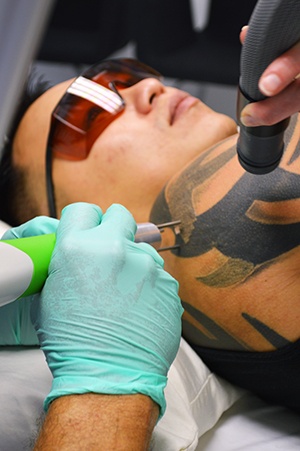 Laser tattoo removal typically does involve some level of hurting. That said, many say that it hurts less than they expected.
It'southward a common belief that tattoo removal is excruciating, yet well-nigh patients say that the sensation of removal is comparable to having a tattoo applied. Common descriptions include the awareness of a prophylactic band snapping against the skin or bacon grease – basically it's uncomfortable but bearable.
It hurts, just it'due south bearable.
When discussing pain with patients, it'due south of import to share that while they may experience some level of discomfort, the pain is relatively manageable and tolerable. Information technology may take some tough love to encourage patients concerned about sensitivity.
The vast majority of tattoo removal providers offering some form of soothing to the skin during the treatment. Offering peel numbing during the procedure allows your practise to stay competitive, provide better patient care, and take higher patient satisfaction.
Offer skin numbing to keep patients feeling happy.
The most popular numbing method is a Zimmer Cryo 6, which is a powerful spooky automobile that blows common cold air on the skin before, during, and afterwards treatments. It's highly effective and an nugget to busy practices that need a solution that is fast and easy-to-use.
Other options for numbing include skilful old-fashioned ice packs, lidocaine injections, or topical numbing creams. Each numbing method has its pros and cons. We take a blog post dedicated to the topic of pain management for this procedure: Skin Numbing for Tattoo Removal Treatments
4. Volition it get out a scar?
Many patients are concerned nigh scarring from laser tattoo removal – they understandably desire their pare to look every bit natural as possible afterwards they've completed the tattoo removal procedure.
If the tattoo already features scarring, expect that to remain.
What many people don't know is that any scarring that remains after a tattoo removal procedure is often left over from when the tattoo was originally applied past the tattoo creative person.
When the proper light amplification by stimulated emission of radiation protocols and patient aftercare are utilized, it's very uncommon for a patient to scar from a Q-switched laser treatment. All the same, it is very common for a tattoo to feature pre-existing scarring from when it was practical.
When a Q-switched laser treats the skin, information technology targets and breaks downwards the tattoo pigment in the skin. If pre-existing scarring is present, it will break down this pigment within the scar tissue. In one case the tattoo removal process is complete, the ink will accept been eliminated from the location but any of the scarring from the original tattoo will probable still remain.
During the initial consultation while you are assessing the tattoo, touch information technology and see if pre-existing scarring is nowadays. If and so, marking it as such in the patient's records and inform the patient that the laser will not eliminate scar tissue, but their ink.
A Q-switched laser is non the best device to use for scar revision and volition not provide pregnant improvement to remaining scarring. Some peel specialists use fractional lasers (such every bit partial CO2 or an Erbium:Yag laser like the Astanza DermaBlate) to resurface scarred peel afterward the tattoo removal process.
Improper aftercare or wrong protocols pose a gamble.
While it is uncommon to crusade scarring from the laser tattoo removal sessions themselves, information technology is nonetheless possible. For example, if yous use excessive fluence when treating a tattoo and cause unwanted side effects (such as immediate pinpoint bleeding), scarring may occur.
Another adventure for scarring, even if the handling is performed properly, happens when patients fail to follow aftercare instructions. Blisters and scabs are common side effects that are of import in the tattoo removal healing procedure. Notwithstanding, picking scabs or not caring properly for blisters tin allow scarring to happen.When discussing aftercare with your patients, make certain to emphasize their office in the outcome of their tattoo removal.
There are also some patients that may have a history of keloids and may be predisposed to scarring, which is why it'due south important to take a detailed medical history of each patient.
Scarring from tattoo removal is highly unusual.
Reassure your patients that you use proper protocols and a professional-grade system that is prophylactic for their skin. Ultimately, as a practitioner, y'all'll withal want the patient to sign a consent form addressing the risks of the procedure and promote a strong emphasis on personal aftercare outside your practice.
five. Can you help me revise this tattoo?
Every tattoo removal practitioner will encounter patients that don't want their tattoos removed completely, simply ratherrevised. Yeah, y'all can provide back up to patients looking for tattoo revision.
Anyone that is a candidate for tattoo removal liked tattoos plenty to become inked at one point in their lives. As a practitioner, you'll desire to be sensitive to this and not assume which tattoo a patient wants removed or whether they want complete removal at all.
Never guess a patient for their tattoos.
We ever suggest starting out the patient consultation with the question, "Which tattoo are y'all looking to treat today?" This question allows the patient to tell their story about their tattoo and discuss their intentions for coming to you.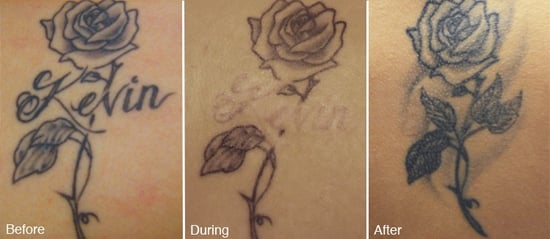
Patients that desire their tattoo artwork revised fit into two categories:
- Selective removal
- Fading prior to a cover-up
Selective removal patients are looking to erase a role out of a larger tattoo piece. This is a common asking for patients with name tattoos. For instance, they like the overall blueprint of their tattoo but dislike that it features an ex-boyfriend'due south name. Patients also asking selective removal if their tattoo artist botched the artwork in an area or the tattoo extended further than they wished – they simply want sure parts of the tattoo "cleaned up." When performing treatments for selective removal, you lot likely volition need precision to only treat the areas of the tattoo that are desired to be removed – usually firing the laser at lower repetition rates will help when treating these specific areas.
Generally, selective removal patients desire complete removal of the specific areas they want erased, but sometimes they want it faded in grooming for a cover-up tattoo.
Cover-up patients merely want their tattoo faded down to arrive easier for their tattoo artist to design a tattoo to be drawn in its place. Tattoo fading needs fewer sessions than complete removal. Frequently 2 to 3 laser sessions are adequate to fade the tattoo significantly and allow the tattoo artist to take a better canvass to piece of work on.
Know the well-regarded tattoo artists in your area.
Having established relationships with local tattoo shops will be a swell asset to your practice. Not simply will you likely get patients referred to y'all past the tattoo shops, you'll also feel confident referring patients to artists that provide quality work for cover-ups, affect-ups, and revisions.
6. Are there side effects?
Side furnishings are to be an expected part of the tattoo removal process for well-nigh patients. In fact, some side effects are an important part of the immune response that helps eliminate ink from the skin.
All patients should expect some level of side effects.
We encourage practitioners to not gloss over side effects during the initial consultation – explicate the various side effects in full detail. This style, when your patients commit to the tattoo removal process, they're informed and aren't shocked the next day when their skin is sensitive and they are potentially limited from their normal activities or wearable.
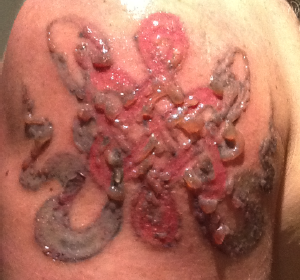 The most common side effects are:
- Redness
- Tenderness
- Swelling
- Blistering
- Scabs
- Bruising
- Hyperpigmentation
- Hypopigmentation
If all of the proper protocols are used based on the tattoo and the patient's skin tone, all of these side furnishings are temporary.Redness, tenderness, and swelling typically subside within a day or 2 following treatment. Blisters usually appear inside 24 hours of handling; sometimes the blisters are very big and may look alarming – this is completely normal. Scabs, bruising, and blistering may take up to a calendar week or longer to heal.
Hyperpigmentation and hypopigmentation occur when the trunk'due south product of melanin is skewed after a laser treatment. With hyperpigmentation, the torso overproduces melanin in reaction to the light amplification by stimulated emission of radiation treatment, then skin in the treated expanse is darker than the natural skin tone. With hypopigmentation, the melanin is depleted by the laser treatment and the skin appears bleached. Both hypopigmentation and hyperpigmentation are typically temporary and resolve naturally with time. Patients with middle to darker skin tones are at the greatest chance for pigmentation changes and should avoid sun exposure the weeks following each treatment.
For patients with pigmentation issues, practice non treat at the regular treatment intervals – look until the expanse has returned to its normal pare tone before treating again. The main chance for permanent pigmentation changes is if the practitioner continues to treat an affected area besides aggressively. Even from the start, information technology is important to treat darker skin tones conservatively – using wavelengths that have less absorption by melanin and reduced fluence levels.
Patients are generally more than concerned of permanent side effects than temporary ones; the side effects that could be permanent are scarring or pigmentation changes. All permanent side furnishings are completely avoidable if the proper protocols and aftercare are used.
Discuss side effects and aftercare together.
We encourage practices to discuss aftercare during the consultation, have aftercare posted clearly on the website, and requite patients a accept-home sheet of aftercare instructions. Much of the aftercare for a tattoo removal treatment are similar to that of aftercare after having a tattoo applied, and so patients should be familiar with it.
7. How does laser tattoo removal work?
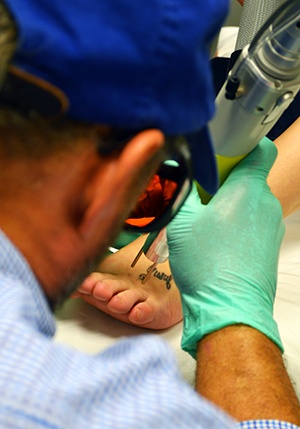 Honestly, this is one of the to the lowest degree common asked questions on this list. Most patients are concerned nearly the results – not how the light amplification by stimulated emission of radiation achieves them. That said, discussing the science behind laser tattoo removal should still be an important role of the patient consultation.
Innovate the discussion of this topic, even if the patient doesn't.
Many patients have the misconception that the laser "burns" the tattoo ink out of the skin. By discussing how tattoo removal works, you tin help patients appreciate the office that the laser (and their body) has in eliminating their unwanted tattoo.
We advise having a simplified answer such as this:
"Each pulse of the light amplification by stimulated emission of radiation sends light energy into your pare. We utilize unlike wavelengths of light amplification by stimulated emission of radiation calorie-free to care for different colors of ink in your tattoo. As the light energy is directed into your peel, information technology is selectively absorbed by the tattoo ink particles trapped in the dermis of your skin. When the ink particles blot this energy, they instantly shatter into tiny fragments. Once the light amplification by stimulated emission of radiation has broken the ink into smaller pieces, your trunk's immune system works to remove the ink over the following weeks, flushing it away from the tattooed area. We see the result of this equally the tattoo lightening in appearance. Each boosted light amplification by stimulated emission of radiation treatment breaks downward more and more than ink until the tattoo tin can no longer be seen."
This description achieves a few things:
- It gives a basic understanding of the tattoo removal process
- It describes the roles that both the laser and the allowed organisation have in achieving results
- Information technology discusses how you customize the treatment based on their unique tattoo
- Information technology explains why it takes time for the ink removal to occur
Informed Patients are Happy Patients
We've seen that if a patient is informed, they're more than probable to proceed with treatment until completion, handle side effects properly, and exist satisfied with their tattoo removal experience.
When patients understand the basics of laser-skin interaction, they know that you are a knowledgeable practitioner with a powerful tool – but not a magician. Expectations are realistic – so patients are encouraged past the fading along the way and pleased with the cease result.
Learn More
Bank check out these other resources from Astanza:
- Patient Share their Tattoo Removal Experiences [Video]
- How to Price Laser Tattoo Removal Treatments
- Marketing Tips for Attracting Tattoo Removal Patients
- Astanza Tattoo Removal Earlier & After Photos

Does Tattoo Frost Once Already Faded,
Source: https://info.astanzalaser.com/blog/7-most-frequently-asked-questions-from-tattoo-removal-patients
Posted by: plummerhisay1971.blogspot.com
0 Response to "Does Tattoo Frost Once Already Faded"
Post a Comment